
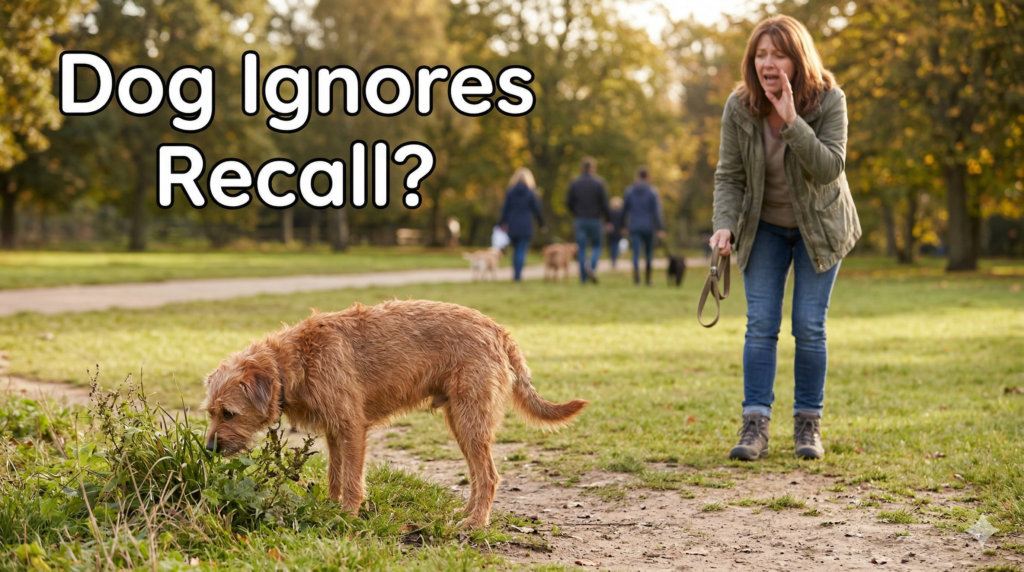
If your dog ignores recall outside, you do not have a “bad dog.” You have a cue that is losing against the environment.
That is a very different problem.
A lot of dogs come back perfectly at home, then act like the word “come” means nothing in the park. That happens when smells, movement, freedom and excitement pay better than returning to you. The cue is there, but the value is not.
The good news is that recall can be rebuilt. Cleanly. Calmly. Step by step.
Why your dog ignores recall outside
Home is easy.
Outside is where recall gets tested for real. There are birds, scents, dogs, people, adrenaline and a hundred better offers than your voice. A recall that works in the kitchen is only the first draft. It is not a reliable dog recall yet.
That is why so many owners feel confused. The dog seems to know the cue, but ignores it when it matters.
Usually the dog is not being rude. Usually the setup is too hard, the reward is too weak or the cue has picked up the wrong meaning.
What a poisoned recall cue means
A poisoned recall cue is a cue that no longer feels clear and safe.
That often happens when “come” gets linked to things the dog does not enjoy. Over time, the dog starts to hesitate, delay or avoid the cue.
Common ways owners poison recall:
- calling the dog only to leave the park
- calling the dog for nail trims, baths or other disliked tasks
- repeating the cue again and again while the dog ignores it
- scolding the dog when it finally comes back
From the human side, that may look reasonable. From the dog’s side, recall starts to mean that fun ends and pressure begins.
1. Stop testing a weak recall in hard places
This is where many owners make the whole thing worse.
If your dog ignores recall in the park, do not keep calling just to see whether it works this time. Every failed rep weakens the cue.
Instead, step back. Train where the dog can win.
That means:
- indoors
- quiet garden
- empty field
- low-distraction space
Do not build recall in chaos.
2. Use a fresh cue if the old one feels dead
If “come” has been repeated too often or tied to too many bad moments, start fresh.
A new recall cue can be:
- a new word
- a whistle
- a short sound you use only for recall
A whistle can help because it always sounds the same. Your voice does not. Your voice changes when you are tired, stressed or annoyed.
Still, the whistle is only the signal. The value comes from the training.
3. Pay better than the environment
This is the real recall battle.
A squirrel is exciting. A scent trail is exciting. Open space is exciting. If you want a reliable dog recall, your reward has to matter.
Start in an easy place. Use the new cue once. Reward the moment your dog turns toward you. Reward again when your dog arrives.
Use food your dog actually cares about. This is not the time for sad dry kibble if your dog is choosing between you and the outside world.
4. Stop ending the fun every single time
If recall always means “game over,” your dog learns something very logical: do not come back too fast.
So change the pattern.
Sometimes call your dog, reward and then release your dog straight back to sniffing, exploring or moving. That teaches a better lesson. Coming back to you does not always shut life down.
Sometimes it sends the dog back to what it wanted in the first place.
5. Use a long line before you trust off-leash freedom
If your dog ignores recall outside, off-leash freedom is too big a test right now.
Use a long line attached to a harness. It gives you safety and stops the dog from rewarding itself by running off. That matters because self-reward is one of the fastest ways to destroy recall work.
A long line is not there to haul the dog in. It is there to protect the training while you build better habits.
6. Say the cue once
One clean cue.
Not three. Not five. Not ten.
If you repeat the recall cue over and over, the dog learns that the first one does not count. The word turns into background noise.
Say it once. Then help the dog succeed:
- move away
- shorten distance
- use the long line
- lower the distraction
- reset the setup
Do not turn recall into wallpaper.
7. Reward the return every time
Even if the dog was slow.
Even if you are annoyed.
Even if the whole park just watched your training fail in public.
If the dog comes back, that moment must stay worth choosing. If you punish the return, you teach the dog that getting back to you is risky. That is how recall gets weaker fast.
You can fix the setup later. But the return itself should stay safe.
Signs your dog ignores recall because the cue is weak
Your recall still needs work if your dog does one or more of these:
- looks at you, then keeps sniffing
- comes only when nothing interesting is happening
- comes halfway, then turns off again
- responds indoors but falls apart outside
- gets slower over time
That is not failure. It is feedback.
It tells you exactly where the training still leaks.
A simple 14-day recall reset
Days 1 to 3
Train indoors or in a boring garden.
- 5 to 8 reps
- new cue once
- reward the turn
- reward arrival
- stop early
Days 4 to 7
Move to a quiet outdoor space.
- long line on
- short sessions
- better rewards
- keep the difficulty low
Days 8 to 14
Add mild distractions.
- more smells
- a bit more distance
- slightly harder timing
Move forward only when the dog is succeeding. Not because you feel hopeful.
Recall mistakes that ruin progress
Calling when you know the dog will fail
That burns reps for no reason.
Calling only for bad news
That poisons the cue.
Repeating the cue
That teaches delay.
Chasing the dog
That often turns the whole thing into a game.
Going off lead too early
That gives the dog too many chances to practice ignoring you.
What to do if your dog runs off instead of coming back
Do not charge toward the dog.
Do not turn the moment into panic and noise if you can help it.
Instead:
- move away
- make yourself interesting
- use the line if attached
- reward heavily when the dog returns
Then look at the setup honestly. A failed recall usually means the difficulty was too high, the reward was too weak or the cue has not been rebuilt enough yet.
When recall problems need a bigger check
Sometimes recall drops because something else is going on.
That can include:
- pain
- discomfort
- stress
- overload
- adolescence
- hormonal changes
Teenage dogs are especially good at making owners question reality. That phase is normal. It still needs structure.
FAQ
Why does my dog ignore recall outside but not at home?
Home has fewer distractions. Outside, smells, movement and excitement often beat the value of the cue. The dog may know the word, but the training is not strong enough for the environment yet.
Can you fix a poisoned recall cue?
Yes. You can rebuild the old cue carefully or switch to a fresh cue and train it cleanly in easier settings before asking for more difficulty.
Should I use a long line for recall training?
Yes. A long line helps prevent the dog from rewarding itself by running off, and it lets you practice recall more safely in real environments.
Should I ever punish my dog for coming back late?
No. If the dog comes back, that return should stay safe and worth choosing. Fix the setup next time, but do not punish the return itself.
How long does it take to build reliable dog recall?
That depends on the dog, the environment and your training consistency. Most owners need to think in weeks and months, not in one good weekend.
Final thought
If your dog ignores recall, do not take it as disrespect.
Take it as information.
Make the cue cleaner. Make the reward better. Make the setup easier. Then build back up until your recall means something again.
That is how reliable recall starts.
Ready to build a recall your dog actually responds to?
Visit our Free Resources page and download the free Smart Dog Owner’s Checklist Bundle — 5 practical checklists covering recall, leash walking, reactivity, calm behavior, and brain games.